January Promotion - 2 Free Plans
The 10-Minute "Peak Incline" EPOC Program - The Treadmill for energy
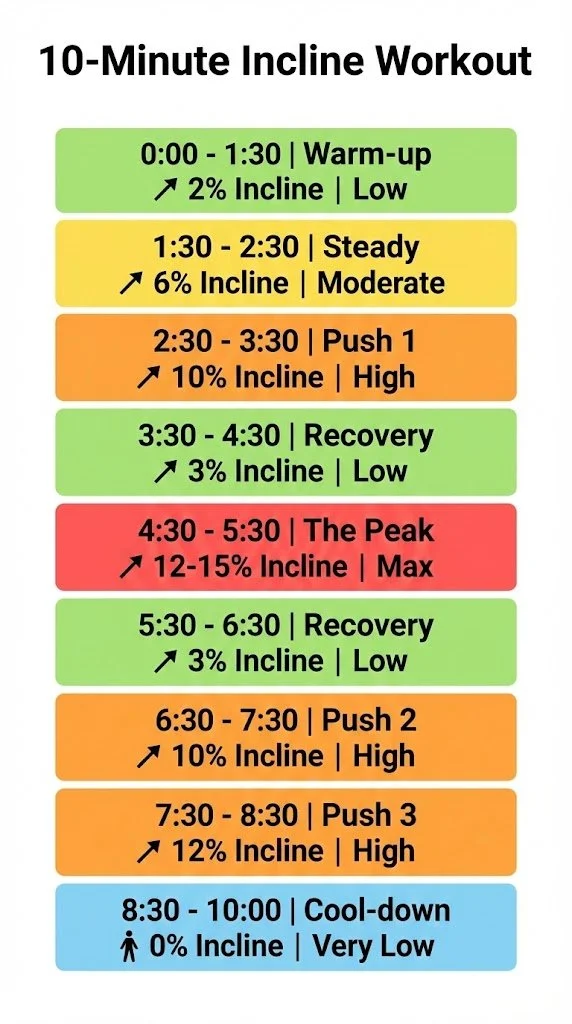
This builds the intensity toward a peak in the middle of the workout, which is highly effective for triggering EPOC because it keeps your heart rate elevated for a sustained period while still giving you those low-impact recovery "valleys."
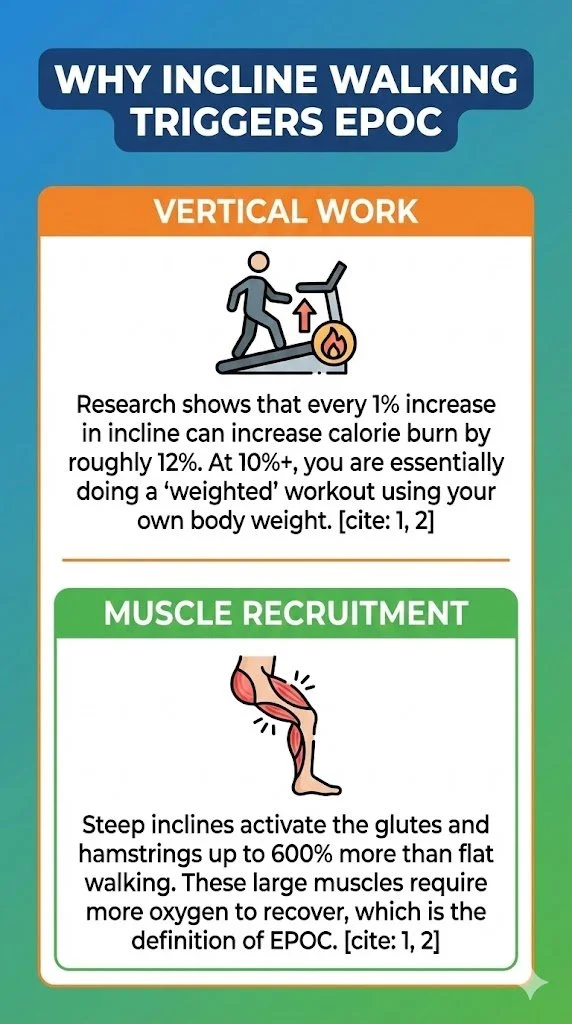
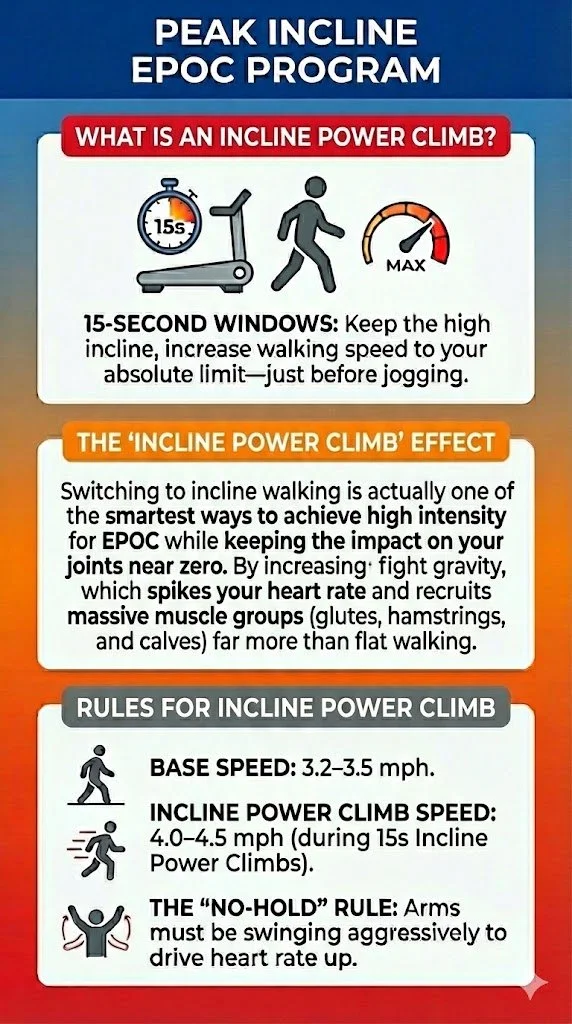
By increasing the incline, you force your body to fight gravity, which spikes your heart rate and recruits massive muscle groups (glutes, hamstrings, and calves) far more than flat walking.
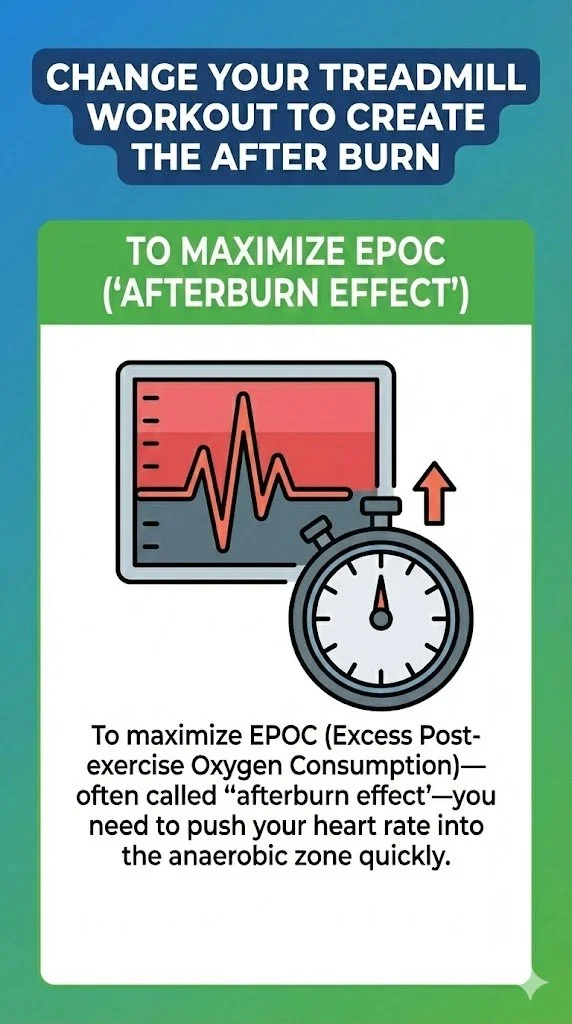
To get the "afterburn" (EPOC) from walking, you must use a steep incline and a brisk pace where you cannot easily hold a conversation.
Speed Tip: Keep your speed between 3.0 – 4.0 mph. The "intensity" comes from the height, not the pace.
Cumulative Fatigue.
Glute Activation: By the 5-minute mark (The Peak), your largest muscle groups are fully recruited.
Metabolic Demand: The "Push 3" at the end (Minute 7:30) is actually harder than "Push 1" because your body is already in an oxygen deficit. This "second wind" effort is what forces the body to work for hours afterward to recover.
Form Check for Low Impact
Don't Lean Back: When the incline gets high, people tend to lean back and hold the rails. This puts stress on your lower back. Instead, lean forward from the ankles (like you're hiking up a real mountain).
Strike Mid-foot: Avoid landing heavy on your heels, which can jar the knees. Try to land softly on your mid-foot.
No "Rail-Surfing": If you have to hold on, the incline is too high or the speed is too fast. Lower one of them until you can pump your arms freely.
Consult your physician before beginning any new exercise program. By participating, you assume all risks of injury and agree that you are in good physical condition. Stop immediately if you feel pain or discomfort
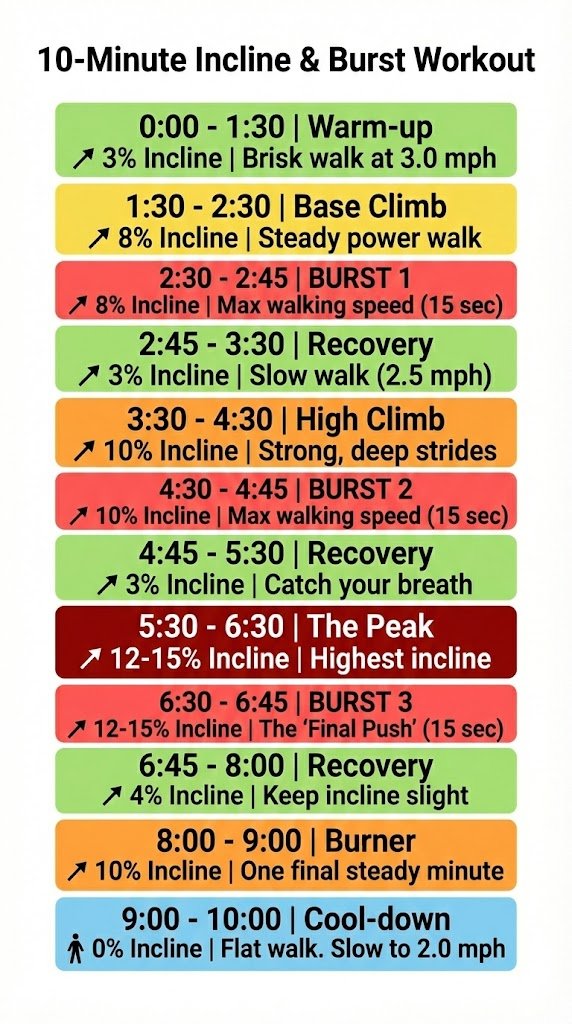
The 10-Minute "Power Burst" Incline Program -Treadmill
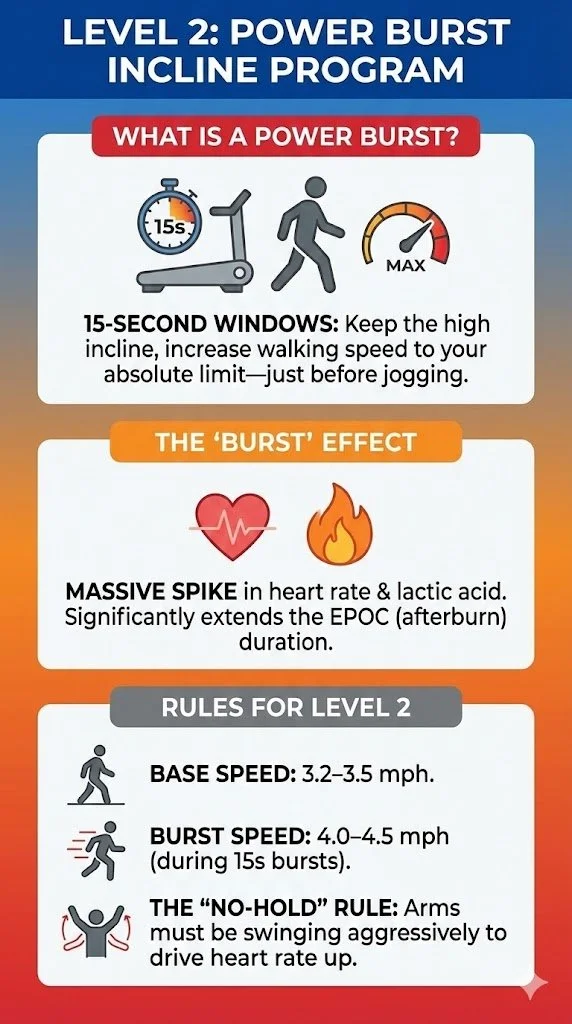
This "burst" method creates a massive spike in heart rate and lactic acid, which significantly extends the duration of the EPOC (afterburn) effect.
These are 15-second windows where you keep the high incline but increase your walking speed to the absolute limit—just before you’d be forced to break into a jog.
Rules for Level 2: * Speed: Base speed is 3.2–3.5 mph.
Burst Speed: During the 15-second bursts, aim for 4.0–4.5 mph.
The "No-Hold" Rule: Arms must be swinging aggressively to drive your heart rate up.
Why the "Power Burst" works
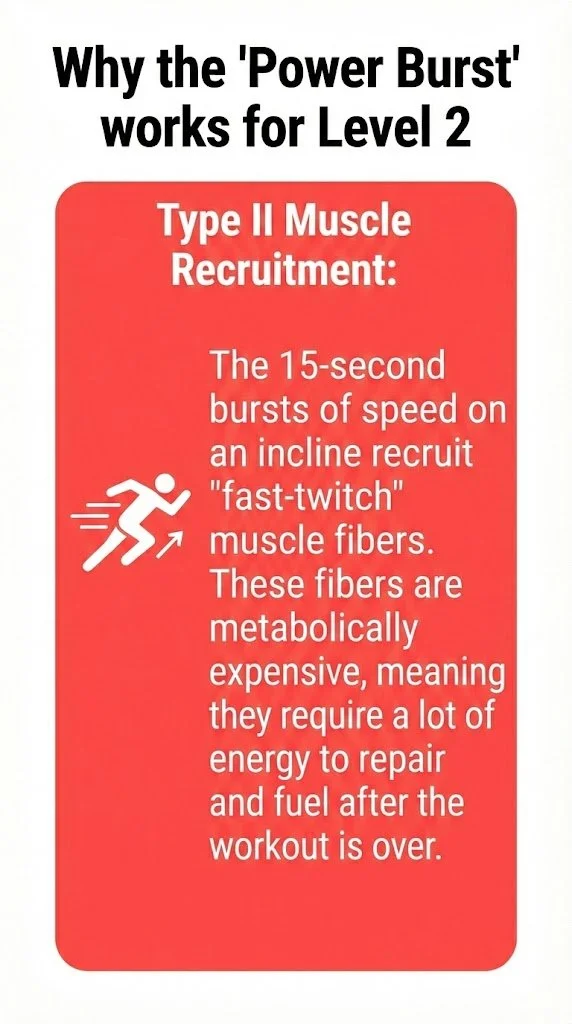
Type II Muscle Recruitment: The 15-second bursts of speed on an incline recruit "fast-twitch" muscle fibers. These fibers are metabolically expensive, meaning they require a lot of energy to repair and fuel after the workout is over.
Micro-Intervals: Shortening the high-intensity burst to 15 seconds allows you to go faster than you could for a full minute, pushing your cardiovascular system into a higher "peak" than the Level 1 workout.
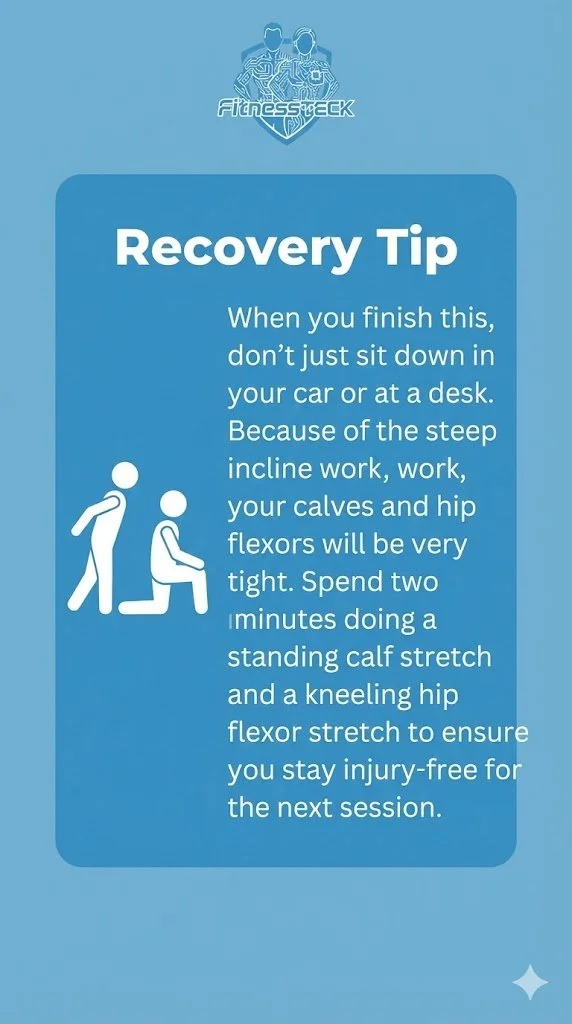
Recovery Tip
When you finish this, don't just sit down in your car or at a desk. Because of the steep incline work, your calves and hip flexors will be very tight. Spend two minutes doing a standing calf stretch and a kneeling hip flexor stretch to ensure you stay injury-free for the next session.
Consult your physician before beginning any new exercise program. By participating, you assume all risks of injury and agree that you are in good physical condition. Stop immediately if you feel pain or discomfort